There's no trick to it — just the right materials, a steady routine, and practice that mirrors the real thing. Here's exactly how to prepare.
Most people who pass comfortably revise over two to four weeks rather than cramming the night before. Short, frequent sessions beat occasional long ones — your memory holds onto road rules far better with a little practice every day.
A realistic target is 20 to 30 minutes a day. That's enough to read a topic, answer a batch of questions, and review what you got wrong without burning out. If your test is sooner, do two short sessions a day rather than one marathon.
Read through the topics and the Highway Code basics. Don't aim for scores yet — just get familiar. Use the topic pages and read a little of the Highway Code each day.
Start answering questions by topic. Keep a note of the ones you get wrong and re-read those rules. Focus on weak areas like safety margins and road signs.
Begin full, timed mock tests. Aim to score 45+ out of 50 consistently — comfortably above the 43 pass mark — before you book.
Revisit only your weak topics and re-take a couple of mocks. Stop cramming the night before; sleep matters more than one extra hour of revision.
Our practice here is free and covers the multiple-choice side well. To go further — especially for the official hazard perception clips, which we don't host — these are the materials genuinely worth your money. The official DVSA titles are the source material the real questions are based on.
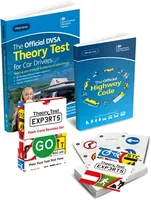
An instructor-approved set pairing the Highway Code with a theory question book and 128 road-sign flash cards — a popular all-in-one gift for new learners.
Check price#ad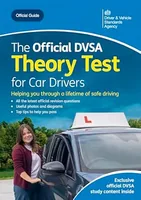
The official revision book holding the bank of multiple-choice questions the real test is drawn from, each with an explanation. (The free official DVSA app is still the best way to practise the hazard perception clips.)
Check price#ad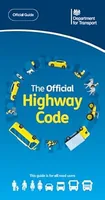
Source material for every theory test. Inexpensive, and worth reading cover to cover at least once — many questions come straight from it.
Check price#ad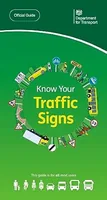
The official guide to UK road signs and markings. If signs are your weak spot, this plus our road signs topic practice will fix it fast.
Check price#ad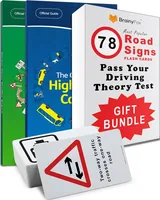
A bundle of the Highway Code, Know Your Traffic Signs and flash cards — handy for revising away from a screen, or as a gift for a new learner.
Check price#adPrices and availability change, so the live Amazon page always shows the current price. Editions are updated each year — look for the latest year in the title.
The test is taken at a centre on a computer, sitting at a desk, with a 57-minute clock and no phone. The more your revision resembles that, the calmer test day feels.
Quick question practice on your phone is great for building knowledge in spare moments. But do your hazard perception practice on a computer with a mouse — clicking a mouse feels different from tapping a screen, and the real test uses a mouse click to mark hazards.
Take full mocks under the real 57-minute limit, in one sitting, without pausing. You'll learn your pace and stop second-guessing — most people finish with time to spare.
Sit at a desk, phone in another room, no music. Doing a couple of mocks this way removes the surprise of a quiet, focused exam room.
Don't just note the right answer — read why. Understanding the rule means you'll get the next, slightly different version of that question right too.
Short, practical reads to sharpen up the areas people find trickiest.
The best revision is active revision. Put a plan into practice with free, full-length mocks and topic-by-topic questions — no sign-up needed.
